







Sunsethue started as a simple idea, with very basic execution. I created a simple model which only used data for your exact location to determine forecasts. The forecasts went live on a very sober website, reaching about ten daily users in the summer of 2022.
About Sunsethue
On a winter evening in February 2022, I was treated to an amazingly colourful and vivid sunset. I thought: wouldn’t it be cool if we could forecast how beautiful a sunset would be? That night, the idea of Sunsethue was born. A couple of weeks later, the first version of Sunsethue was ready, with about the same accuracy as flipping a coin.
Since then, Sunsethue has come a long way. Most importantly, the forecasts have improved with the introduction of the ray-based methodology. Besides that, I built an API which powers many hobby projects and some bigger mobile apps, and launched a mobile app for Sunsethue, among other things.
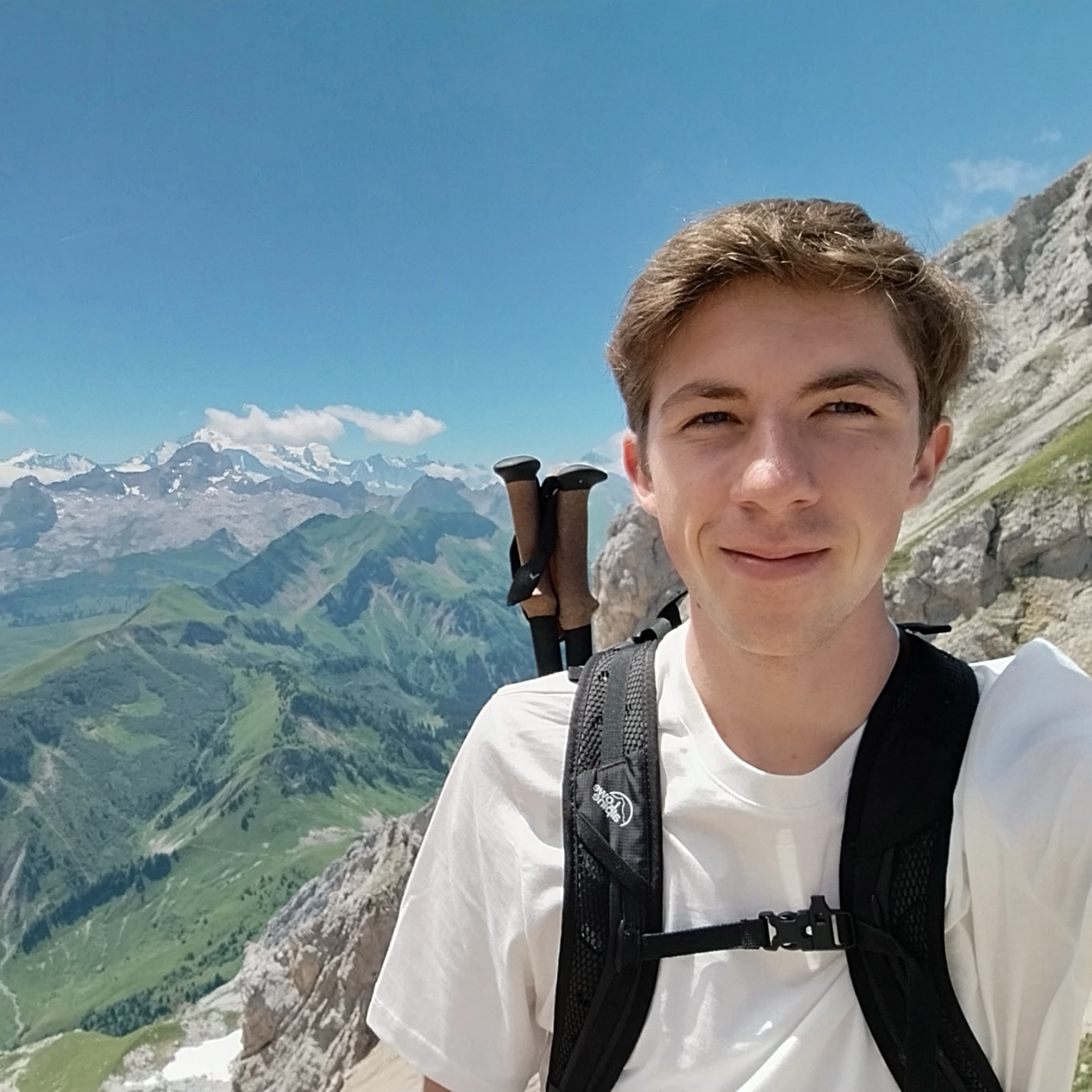
Hi, I'm Maarten Laureyssen! I'm a computer science student in my last master's year at KU Leuven (Belgium), with a specialisation in AI. Besides computer science, I have a big interest in meteorology, and as such, I'm doing my master's thesis in the field of AI weather models.
I'm running Sunsethue in my free time: what started as a small side project has grown into a service many people rely on daily. Building Sunsethue has been a very fun challenge. I especially enjoy researching better ways to forecast sunset quality because it is a perfect match between computer science (algorithms) and meteorology.
For all inquiries, questions, and feedback, email me at:
PERSONAL SITE — TCUMULUS.DEVThe history of Sunsethue
From a tiny forecasting experiment to apps used around the world.
After a lot of manual verification of the forecasts and some incremental improvements made to the model since its inception, Sunsethue Alerts were launched. Users could now sign up for email alerts when the sunset was forecast to be worth it.
A summer break spent researching how to improve the Sunsethue model resulted in a completely new methodology: a ray-based model (see ray-based model). This model improved the accuracy of the forecasts by accounting for all clouds in your surroundings, as opposed to solely your exact location.
The first public version of the API was released. From hobby projects to big mobile apps, people started using the API to build amazing things.
A variety of improvements and new features were introduced in 2025, from forecast maps to increased model resolution and more frequent model runs. This was also the year in which I managed to fully cover my costs through users signing up for Sunsethue Alerts Premium.
With a complete rewrite of the model code, the v3 version of the ray-based model allowed me to increase the model resolution and add a lot of new data: cloud cover and quality per level, clouds at the horizon, uncertainty, and much more.
The long-awaited Sunsethue mobile app for iOS and Android launched in the summer of 2026, initially with only an updated forecast screen, more informative event pages, and native sunrise and sunset alerts.
Sunsethue Alerts was rebranded as Sunsethue Glow with the addition of interactive forecast maps and widgets in the mobile app. The mobile app also hit its first milestone: 5,000 downloads across both platforms.
Sunsethue Atlas launched with historical sunrise and sunset data for the whole world. Transparency efforts led to the establishment of a public accuracy page, to see how well Sunsethue's forecasts are doing.
Sunsethue in numbers
Updated November 13, 2026
Mobile app
- 9.7k total downloads (7.8k on iOS, 1.9k on Android)
- 4.8/5 rating (78 ratings)
- 1,200 daily users, 7,100 monthly users
- 400 Glow users
API
- 1.9M requests per month
- 200k requests for external users
Alerts (legacy)
- >3,500 users
- >250,000 alerts sent
Ray-based model
This new way of making predictions is more complex, but the main thing is that it accounts for all clouds that may affect the sunrise or sunset, even if they are far away. To explain it in simple terms: rays are cast in the direction of sunset, based on the cloud cover along the ray, a quality metric is computed. A cloud which is situated over 400km (250mi) can block the sun at sunset, and that is now accounted for.
In the summer of 2025 I took some time to restructure the underlying code to make it easier to add different metrics, like for example the highlight time metric. With this restructuring, you are now also able to check the composite sunrise and sunset forecast maps for Europe, North America and Australia without having to scroll through different timesteps.
After in-depth testing by comparing the predictions to actual sunsets (on webcams), it became clear that this new method is greatly outperforming the previous way of forecasting. In the autumn of 2024, this new model got introduced together with a complete redesign of the web app.
In the spring of 2026, the new v3 version of the Sunsethue ray-based model went live. This update consisted of a complete rewrite of the code, with the addition of many new (experimental) metrics to show for. The more efficient code also led to an increase in resolution and number of runs.
READ MOREStructure of Sunsethue
I decided to build Sunsethue in multiple components: the Sunsethue model, the API and the website. Two times a day, the model runs using data from the german ICON weather model, and calculates the metrics for all locations worldwide. These forecasts can then be accessed using the API. The web app uses this API to display the forecasts in a user-friendly way.
Besides that, I decided to keep the website and API separate, so that other people and services can access the API as well. The API is documented and can be used for free in your own projects. In the future, there will also be a paid commercial plan, so that (hopefully) you will be able to access Sunsethue’s forecasts through other apps and websites as well.
SUNSETHUE APIMission
Sunsethue exists for anyone who wants to know if the sunrise or sunset will be worth it. For people who like to wonder at the spectacle or professional photographers who need the best light to capture the most amazing pictures.
A beautiful sunrise or sunset is something positive, something that can inspire and bring people together. Besides serving people who are actively searching for a sunrise or sunset forecast, I also want to reach people who might never go outside to attend the spectacle. I hope Sunsethue may help spread the power of a vivid sunrise or sunset to more people, by providing forecasts where anyone can rely on.
Future visions
The main goal of Sunsethue is to provide accurate sunrise and sunset forecasts. The focus will therefore remain on improvements and new innovations in forecasting technology. This is also where my personal interest lies. Innovative features such as predicting the duration and colour of a sunrise or sunset, or even generating an example rendering, are things I’d like to research in the future.
I also want to incorporate more weather model data sources to allow for better and more nuanced predictions. To provide an even broader perspective, I want to create a global sunrise and sunset atlas to explore where and when (historically speaking) the best sunrises and sunsets occur. I also want to look into accounting for more local effects, such as orography, to make predictions even more location-specific.
Supporting Sunsethue
Sunsethue started out as a small side project but has grown into a sizable service. I’ve put a lot of time into it, and I’m proud of what it has become so far. Still, there are plenty of improvements to be made. Sunsethue is already attracting sunset lovers worldwide, but there are still many people missing out on potentially beautiful upcoming sunsets.
The best way to support Sunsethue is to spread the word! Besides that, feedback also helps me a lot, so if you have any feedback or ideas, please let me know!
GIVE FEEDBACK© 2026 - Sunsethue (v0.11.1-beta)
-
Made in Europe
